The Einstein Telescope: bridging science and art
As the culmination of her master’s degree in photography, Marijke Beckers will publish an art book in a few months’ time. The millions-of-years-old drill cores of the Einstein Telescope have been a true source of inspiration for her.
When Marijke Beckers decided a few years ago to deepen her work as a photographer and graphic designer by pursuing a master’s degree in photography, the choice of her final project came quickly: to create a photographic connection between science and art. The foundation: the elusive nature of the phenomenon of “time,” structured around the Einstein Telescope.

A touch of magic
“Time is barely comprehensible. I’ve always been interested in science—black holes, colliding stars—and then you also encounter the curvature of space and time. The fact that the Einstein Telescope will soon be able to measure gravitational waves much more extensively and accurately, expanding our knowledge of them, is almost magical,” Marijke explains.
To translate this fascination into her photographic project, she was welcomed at KU Leuven, where experiments are conducted on mirror coatings. She also photographed at Werkhuizen Hengelhoef in Genk, one of the partners in the Beampipes4ET consortium, which is working on vacuum technology for the tube system.
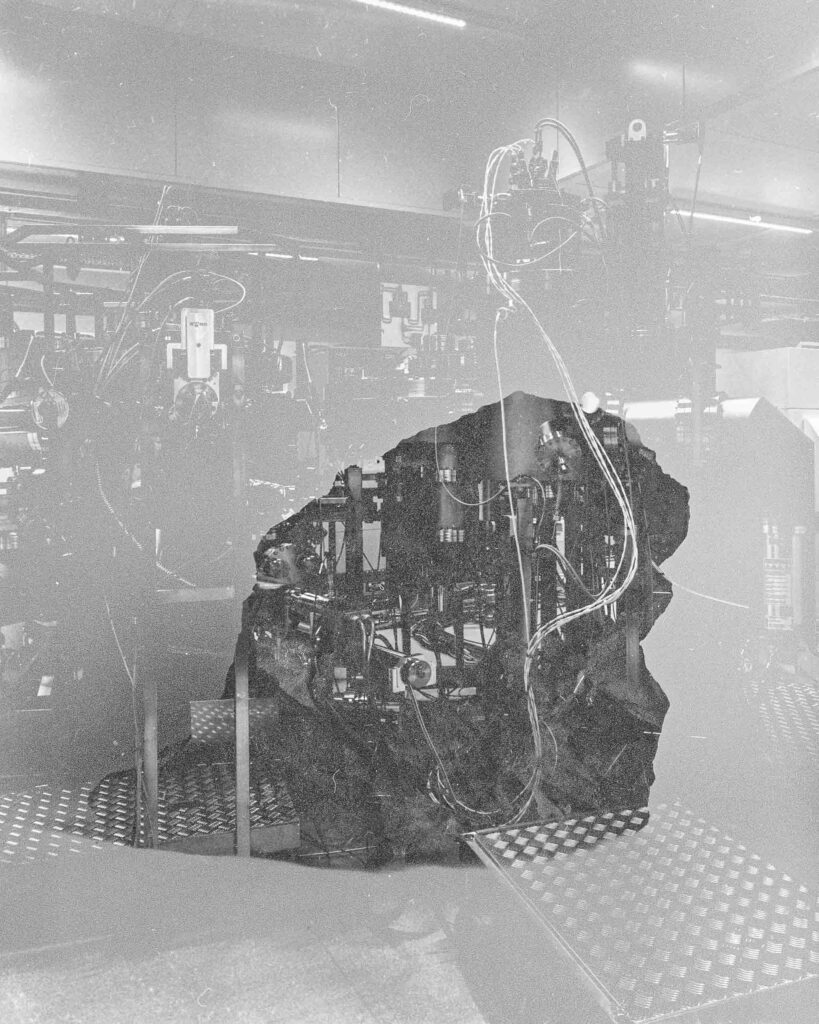
Aubel
As a child, Marijke Beckers was already fascinated by stones, which tell something about time. Even today, she often carries a stone in the pocket of her jacket—just like her children.
Her research led her to visit a deep drilling site as well as the core house in Aubel, where drill cores are stored, catalogued, and studied. “I went there twice. The first time was at the invitation of geologist Rudy Swennen. He explained things so captivatingly that I barely had time to take photographs. Fortunately, I was able to return a second time. That day, hydrogeologist Bjorn Vink was there, equally enthusiastic. It resulted in some beautiful images.”
The icing on the cake
Her most memorable study visit was to the ETPathfinder in Maastricht: “I received explanations there from Jurgen van Gorp. What you see is already incredible, but when you also get such expert and passionate explanations as he gave, your day is truly complete.”
Her inspiration
It is not only the universe itself, the phenomenon of time, or figures such as the Leuven-based cosmologist and professor Thomas Hertog that inspire Marijke. The book Reality Is Not What It Seems: The Journey to Quantum Gravity by Carlo Rovelli also played an important role. In it, Rovelli explains how our understanding of reality has evolved over the centuries, offering a new vision of the universe, with ideas about parallel universes and a cosmology without a Big Bang.

An art book
Her final project at LUCA School of Arts in Genk is expected to be completed around June. Marijke plans to publish it herself as an art book. “It will be a self-published book, structured around three narrative layers: a scientific dimension, a geological approach, and a metaphysical dimension, all connected by the theme of time. It is my reflection on science and art. Their modes of expression differ, but both are driven by a particular kind of curiosity. That’s the connection I want to explore.”
Geology
It is no coincidence that this largely unfolds through the geology of the ground where the Einstein Telescope is to be built. “When you look at a drill core and realize the rock is millions of years old, the notion of time immediately resurfaces. What does such a stone tell you? You keep reflecting on it. That is also what the third part is about: my own metaphysical experience during this project.”
What’s next?
A book will be published, and her work will soon be exhibited at the cultural center in Hasselt as part of a group exhibition from June 19 to 21. But Marijke Beckers does not intend to stop there, provided she can secure funding: “I see this as a first chapter. I want to continue, because there is still so much interesting material to explore.”

This image illustrates the passage of time through the path traced by the sun. What remains after the photographic process is only the trace it has left behind. In this way, a specific duration is not only captured but also made materially visible within the image.


