Interesting discussions during eight drop-in sessions
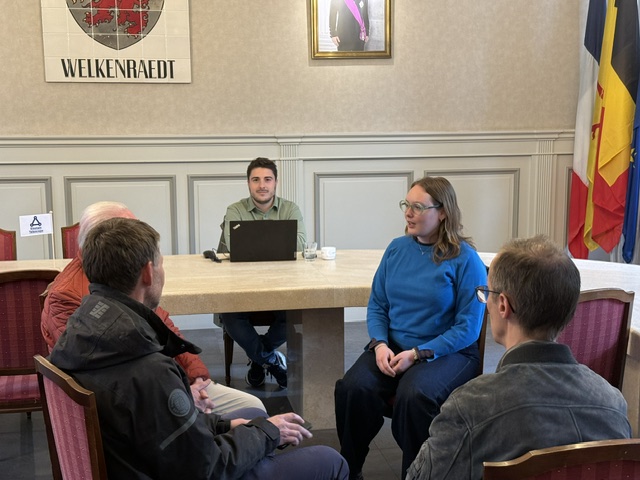
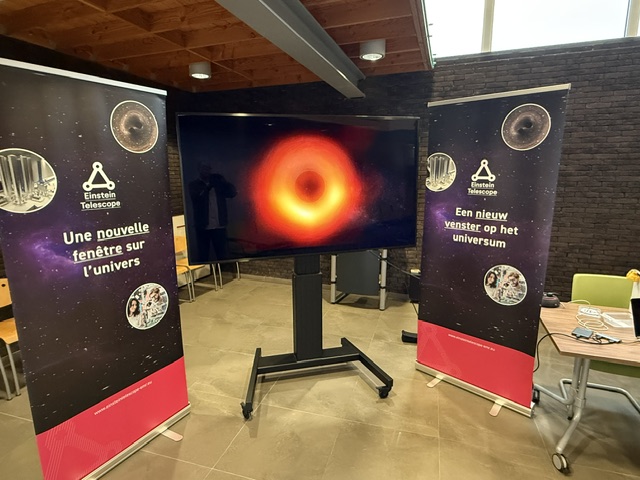
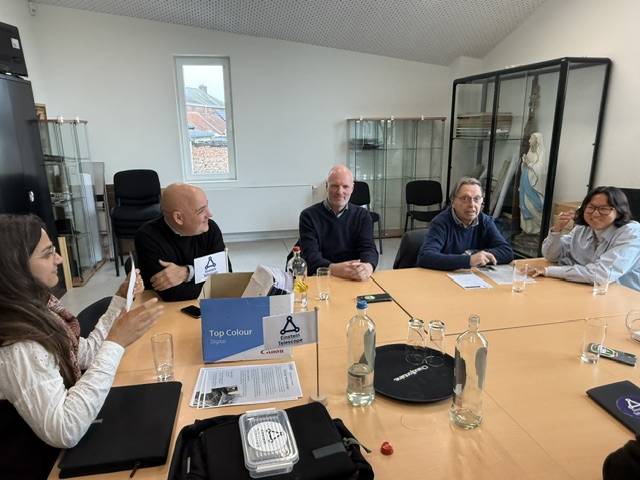
Under the slogan ‘Got a question? Pop in!’, the project office organised eight drop-in sessions in May and June for residents of the Einstein Telescope’s search area. It wasn’t particularly busy, but it led to some interesting discussions.
One lady had been particularly creative and innovative: using AI (artificial intelligence), she had listed the fourteen locations where the project office had carried out deep drilling in 2024, 2025 and this year. She then asked the AI where, logically, the underground triangle would be built.
The project office was unable to confirm the AI’s answer: the location for the underground triangle has not yet been finalised. A passive seismic survey is still underway, and an active seismic survey is yet to follow. The results of both will play a part in the final decision.
Furthermore, whilst the deep drilling, seismic surveys and hydrological studies in the search area may determine which location is the best from an underground perspective, they do not take into account what is important above ground. Natura 2000 sites, for example. Or the logistical possibilities for removing excavated soil and delivering materials, for instance. Or the agreement with the Bocageland Landscape Park to leave the landscape in a better state after the construction of the Einstein Telescope than we find it now. In short, AI did not yet have all those pieces of the jigsaw fully in place.
Grandchildren
The lady had come to the open-house meeting because she is very interested in the Einstein Telescope – in the science behind it – and because that telescope might one day offer a job for her grandchildren. But her attendance was also driven by concern. Her AI experiment had, in fact, identified an underground node close to her own home. The option of not digging at the site itself, but in a diagonal trajectory from a distance of one and a half kilometres, did not entirely put her mind at ease. Seeing is believing.
Interest
It wasn’t particularly busy during the eight drop-in sessions in Banholt, Aubel, Welkenraedt, Vijlen, Herve, Voeren, Epen and Plombières. On the odd occasion, the mayor popped in briefly; sometimes one or a few councillors were present. Sometimes there was a group discussion; on one occasion, just one resident with a question; on another, ten people. At one venue, the regional broadcaster did a nice feature on it. Did we not publicise it enough? Or was the turnout too low because we’d mentioned in the announcements that the session was intended for questions, but that there would be no ‘news’ to report regarding the location of the Einstein Telescope?
Impact
A common thread running through all the drop-in sessions was the impact of the construction period, which is set to last eight years. What will it all mean for the region? The efforts to reuse soil and materials as much as possible, or to transport them by rail because that is more sustainable and means fewer lorries, are appreciated. Absolutely, but how many lorries will still have to be on the road? And where? Will separate roads be needed for them in future? These are all extremely relevant questions, but ones to which no ready-made answer can be given at this stage. Because those answers depend on the choice of location, the overall feasibility, and the final choice of location between our region (Euregio Meuse-Rhine) and the competing proposals from Sardinia and Saxony. Not everyone was satisfied with that answer. One lady phrased it as a warning: if lorries are driving through the village all day long, we’ll all sit down on the road… To which another visitor responded reassuringly that the lady didn’t mean it as badly as it sounded.