World’s largest mono-crystalline silicon mirror produced for the Einstein Telescope
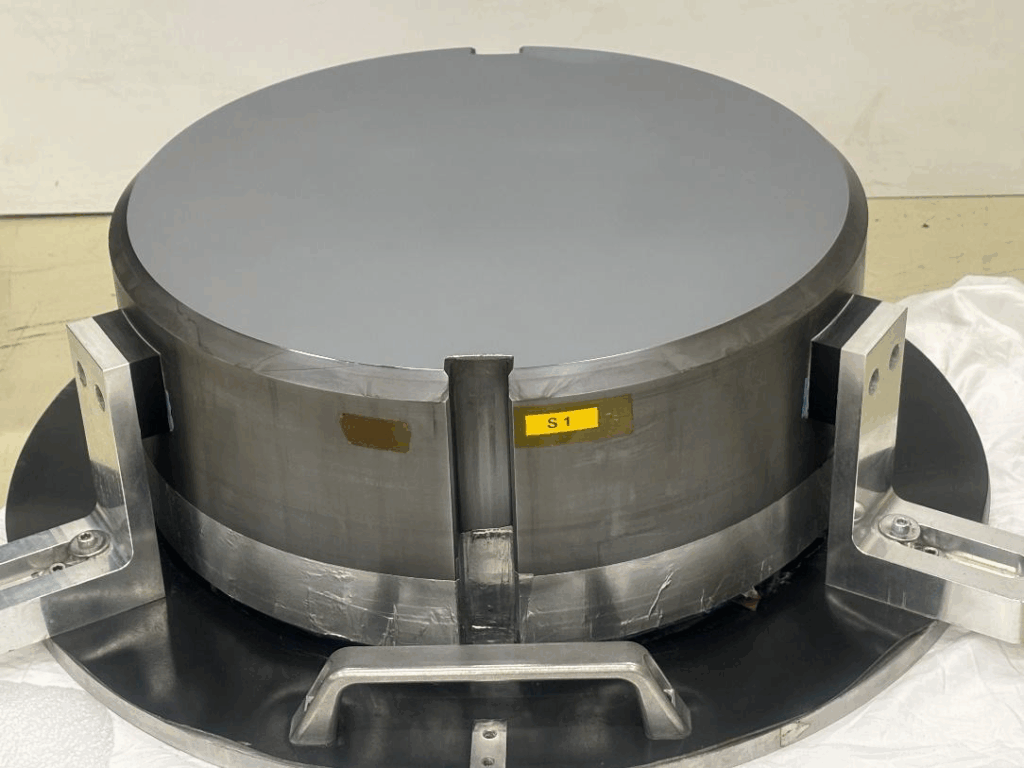
Measuring 45 centimetres in diameter and weighing some 80 kilograms, the monocrystalline silicon mirror set to join the ET-CRISTAL laboratory in Liège is the largest ever manufactured in the world. Polished in Wallonia (Belgium) by AMOS as part of Prof. Christophe Collette’s (University of Liège) ERC SILENT project, it is paving the way for the technologies of the future Einstein telescope, the next-generation gravitational wave detector.
More than five years ago, an ambitious project was launched by Prof. Christophe Collette, an aerospace engineer at the University of Liège, involving the design and manufacture of a very large mono-crystalline silicon mirror, intended to push the boundaries of optical technologies for fundamental research. “The raw ingot was produced by a specialist American company, a supplier of equipment for growing silicon crystals,” explains the researcher, “before being entrusted to AMOS for machining and polishing.”
This collaboration has now resulted in an exceptional achievement: a mirror 45 centimetres in diameter, weighing around 80 kilograms, with a residual roughness after polishing in the order of a nanometre – that is, surface irregularities a million times smaller than a millimetre!
The 45-centimetre diameter is remarkable in itself, as producing a silicon single crystal of this size – free from defects and grain boundaries – is at the very limit of what crystal growth processes currently allow. This piece is therefore the largest single-crystal silicon mirror produced to date! Although its performance does not yet meet all the specifications targeted for the future Einstein Telescope, it represents the state of the art closest to these requirements.
Turning an ingot into a mirror
It all begins with a monocrystalline silicon ingot, a solid cylinder formed from a single crystal, drawn very slowly from a bath of molten silicon. This crystal growth was carried out by an American company specialising in the manufacture of machinery dedicated to this type of application. To date, very few companies are capable of producing silicon single crystals of this diameter. At this scale, the slightest impurity or dislocation would compromise the crystal’s homogeneity, which is what makes a 45-centimetre-diameter single crystal so rare.
Once the ingot was delivered to Belgium, the machining was entrusted to AMOS, a spin-off from the University of Liège. Silicon is a hard but fragile material that tolerates no errors; even a slight miscalculation would have been enough to crack it.
“The ingot was first cut and then shaped using diamond tools, the only ones capable of cutting into the crystal,” explains Philippe Klinkenberg, Head of Optics manufacturing at AMOS. “This was followed by lengthy lapping and polishing stages, during which increasingly fine abrasives gradually removed the micro-damage left beneath the surface by the previous steps. Each pass was checked using high-precision optical metrology, until a residual roughness of around one nanometre was achieved.”
In total, it took six months of machining and polishing to transform the raw ingot into a precision mirror.
The mirror will be installed in the new ET-CRISTAL (CRyogenic and Inertial STAbility Lab) laboratory by the end of the year. Located in the new buildings of the Liège Space Centre (CSL) – to benefit from the CSL’s expertise in cryogenics and cleanroom technology – the laboratory will house an additional three-metre-diameter vacuum chamber, in which the E-TEST prototype will be installed for further development. The mirror will serve as an experimental platform for the development and validation of technologies intended for next-generation gravitational detectors and, ultimately, for the Einstein Telescope.


