Albert Einstein: the man behind the genius
More than seventy years after his death, Albert Einstein continues to inspire people. Not only with his ideas about space, time and the universe, but also as a person who reflected on peace, responsibility and the consequences of scientific progress.
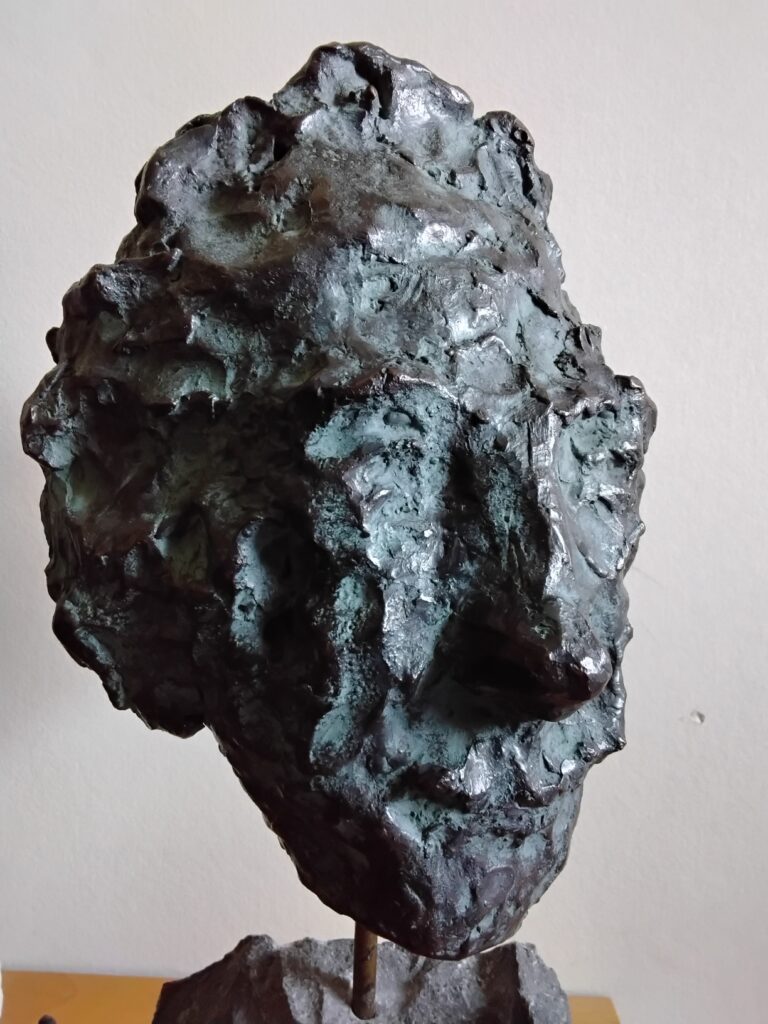
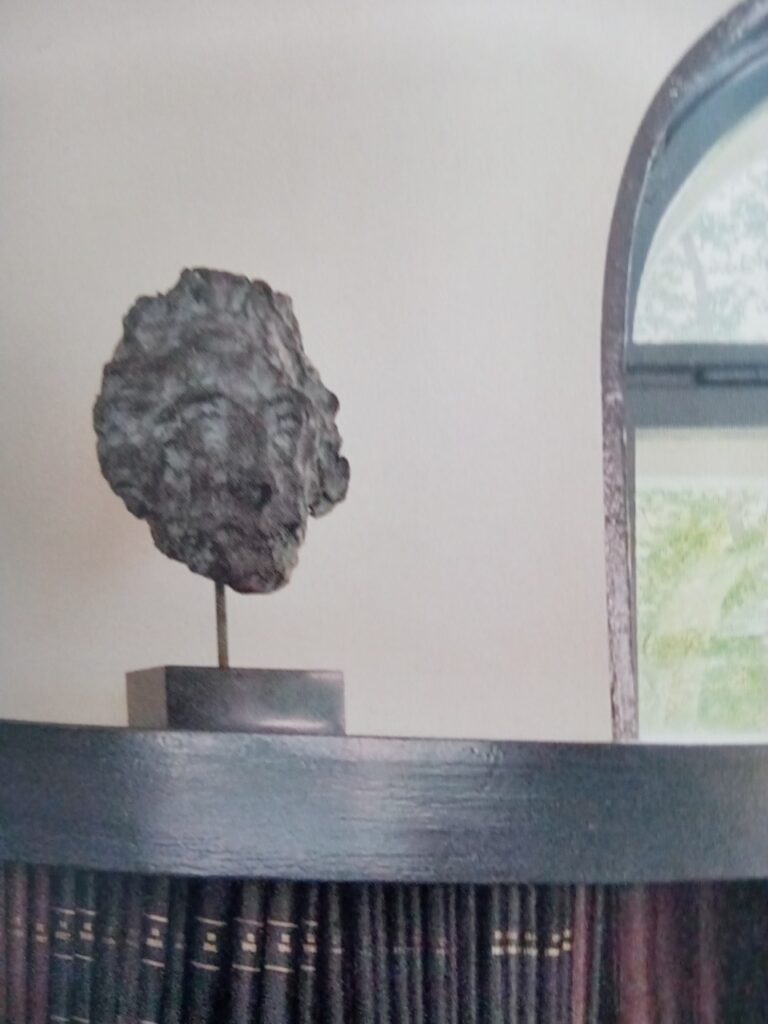
Sculptor Bernie Gogelein-Autsema (86) from Laren (NL) was also captivated by him. In her bronze sculpture of Einstein’s head, she was not seeking to capture the world-famous genius, but rather the man behind Einstein: with his humour, modesty, sadness and doubts.
Sadness, humour and resignation
When Bernie started working on her sculpture of Einstein around 2020, she did not want to create a heroic figure. She looked at photos of him and noticed something else. “I saw a modest intellectual, someone with a sense of humour, but also a certain sadness about the way his life had turned out.” She tried to capture those emotions in clay: sadness, humour and resignation.
She also reflected on the complex relationship between science and responsibility that Einstein had to grapple with throughout his life. In 1939, he warned the American President, Franklin D. Roosevelt, of the possibility that Germany might develop an atomic bomb. His warning prompted the US government to carry out further research into nuclear fission. A few years later, this led to the development of the first atomic bombs. Einstein himself did not take part in that. Later, he campaigned for peace and warned of the dangers of nuclear weapons.
For Bernie, that history is also part of his portrait. Not just the genius, but the man who reflected on the consequences of scientific progress.
Thinking and feeling with your hands
The image came to her at home, while Bernie was looking out over the garden. She had already done a great deal of drawing and painting, but later in life she discovered just how well three-dimensional work suited her. “I’ve got a lump of clay in my hands and I get to work. Then I’ll just see how it goes.”
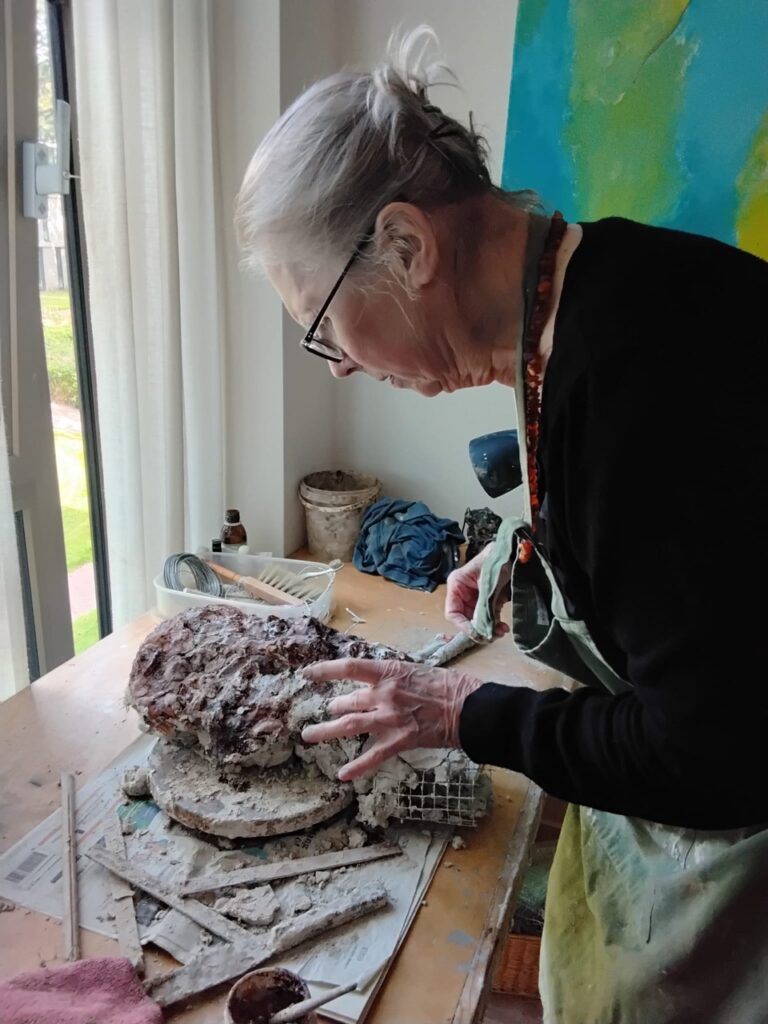
She attended art school, but for many years she largely put her career as an independent artist on hold to focus on her family. Over the past twenty years, art has once again come to play an increasingly important role in her life. Eventually, she took up sculpting. “If only I’d done that sooner.”
It is precisely the sense of space that appeals to her. For her, a portrait is created not only by looking, but also by feeling: the proportions of a face, its shape, and the way light and shadow play across its surface. She sees a similarity between this and science. A researcher may start with an insight and must then find out whether it is correct. For her, it all starts with clay and an idea. The idea then takes form as the work progresses.
Einstein back in Potsdam and Leiden
Bernie first modelled Einstein’s head in clay. She then had three copies of the final clay head cast in bronze. She knew where one of them belonged: the ‘Einsteinturm’ in Potsdam, Berlin, named after him.
The Einsteinturm, designed by the architect Erich Mendelsohn and built in the early 1920s, is a solar observatory. By measuring sunlight, scientists wanted to investigate predictions related to Einstein’s theory of relativity. Einstein himself used to spend time at the observatory and supported the research.
It was precisely because of that history that Bernie wanted to house her sculpture there. The sculpture received a festive welcome in Potsdam and is now on display in a room that is visited during guided tours. “I wanted to put him back in his rightful place, as it were.”
The city of Leiden also plays a part in her story. Einstein had a long-standing academic connection with Leiden University and often stayed in the city. Bernie himself lived opposite the Leiden Observatory for many years. She donated the second copy of her Einstein to the Old Observatory in Leiden.
Where is the human element?
Bernie is fascinated by Einstein’s ideas about the cosmos and his references to Spinoza. The idea that human beings are part of a much larger whole appeals to her.
She was also moved by a text that became known on the internet as a letter from Einstein to his daughter Lieserl, in which love is described as a universal force. There is no historical evidence that Einstein actually wrote that text. For Bernie, it is above all about the idea behind it: science and progress must not be separated from humanity. “We’re drowning in science, but where has the human element gone?”
She also considers that question to be relevant in the context of contemporary developments such as artificial intelligence. She is not opposed to new technology. “It’s a tool. You have to grow with it, but you also have to master it.”
Einstein looks to the future
For Bernie, Potsdam and Leiden are places where Einstein’s history remains tangible. The Einstein Telescope, on the other hand, looks to the future. The future gravitational-wave observatory builds on Einstein’s general theory of relativity and is set to provide researchers with new opportunities to study the universe.
That idea really appeals to her. In her view, Einstein need not be merely a historical figure. His ideas live on in modern science. “We let him be present at his own future,” she says. With a smile, she even sees him as a sort of ‘overall supervisor’.
One bronze Einstein is still waiting to be placed somewhere. Perhaps it is precisely that sculpture that will one day forge a link between Einstein’s past and tomorrow’s science. Not as a monument to an untouchable genius, but as a reminder of the man behind the science and of the responsibility that comes with knowledge.