Noise study delivers promising results
It is a key issue in the feasibility study for the Einstein Telescope in the Euregio Meuse-Rhine: to what extent is disruption caused by noise from, for example, railways or industry that penetrates deep into the subsurface? The results of the noise study are very positive, but not yet complete. With that disclaimer in mind, here are a few questions for scientific director Stan Bentvelsen.
First of all: what does a study like this look like?
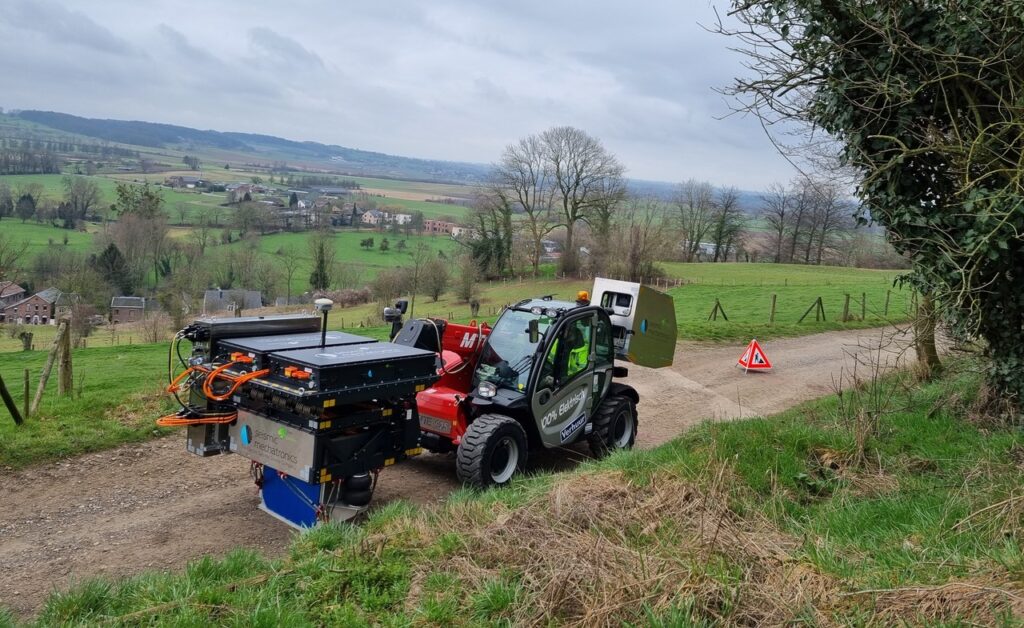
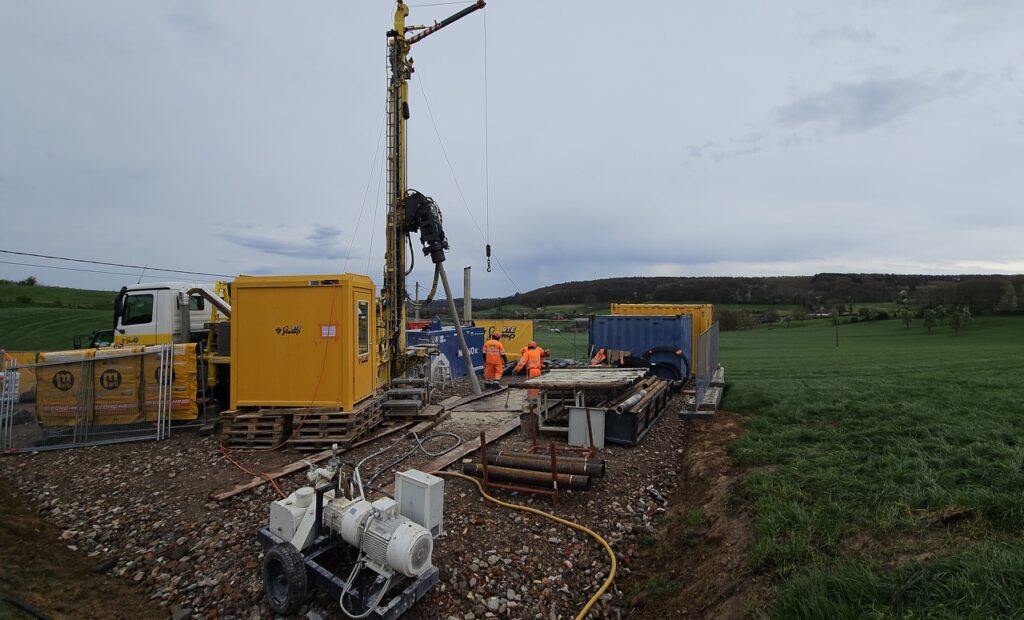
Stan Bentvelsen: “To get a clear picture of noise or vibrations in the ground, we carry out seismic surveys. Over a period of time – usually a few weeks – a sensor records the seismic vibrations caused by human activity and natural phenomena, such as flowing water, industrial plants, wind turbines, train traffic or an aircraft landing. We typically install one sensor deep inside a borehole using a special cable that reaches the bottom of the borehole, and another sensor on the surface, near the borehole. This enables us to observe the vibrations at the surface and study how much of them remains at depth, at the site where the Einstein Telescope might be built.”
And those initial findings from the environmental noise study look promising?
Stan Bentvelsen: “Yes, that’s right. This is an important part of the study, and it was quite exciting to see how it would turn out. After all, the Einstein Telescope can only function properly if those vibrations – which we always refer to as ‘noise’ – are completely absent, or if the noise present can be filtered out using special measures. Bearing in mind that we still need to carry out measurements at one location, the results we have so far can be described as ‘good’.”
So how do you decide that?
Stan Bentvelsen: “We already made a borehole in Terziet (Dutch municipality of Gulpen-Wittem) several years ago. We regard the result of the noise measurement for that borehole as our baseline. Any more noise than in Terziet would be a poor outcome. However, measurements taken at boreholes in Hoof (Belgian municipality of Welkenraedt) and Beusdael (Belgian municipality of Plombières) fortunately show significantly less noise. The graphs show the amplitude of the vibrations as a function of their frequency, measured in hertz. And those are below Terziet’s level. That’s good news, and we’re very pleased about it. The results were presented to the Task Force a week and a half ago.”
Does this mean it has been confirmed that the Einstein Telescope can be built in this Euregio, and that its exact location has also been decided?
Stan Bentvelsen: “Let me put it this way: from an underground perspective, it looks very encouraging.”
What still needs to be done?
Stan Bentvelsen: “As mentioned, we still need to measure the noise levels at the drilling site in Asse. This has not yet been done due to a number of factors; we have encountered some delays. So that’s still to come. Even so, we can already say something about it, namely that the sensors on the surface show that it is much calmer there than in the vicinity of the other boreholes. So we’re not really too worried about it, but of course research still needs to prove that. A few analyses are also yet to be finalised.”
And then?
Stan Bentvelsen: “Our biggest challenge now will be to study other types of vibrations. One of these is what is known as ‘Newtonian noise’. This is a rather subtle effect caused by the interaction between seismic vibrations and the geology. Ultimately, it will determine how well the Einstein Telescope performs. We also need to map out subtle magnetic vibrations typically caused by trains in the region, and we’re even studying infrasonic sound – that is, sound at very low frequencies.”
So quite a lot still needs to be done. Can it all be done in time? Is the bid book expected at the end of this year?
Stan Bentvelsen: “The studies are continuing while work on the bid book is already under way. Right up till the very last day. What people need to realise is that, ultimately, it is a question of arriving at as accurate an assessment as possible of whether the project is feasible. Can we build the telescope here in such a way that it will work properly? People sometimes confuse that with an implementation plan that has been worked out down to the last comma. That’s really a different matter altogether and something for a later stage.”
You spoke of ‘special measures’ to filter out excess noise. Suppose this were necessary – what would those measures consist of?
Stan Bentvelsen: “Mitigating measures might include installing a number of sensors around the site where the Einstein Telescope is located. With these sensors you can, as it were, see the seismic vibrations coming and predict what effect they will have on the measurements carried out by the Einstein Telescope. And that tells you that those vibrations aren’t gravitational waves, so you can filter them out.”
That’s it?
Stan Bentvelsen: “Yes, but we still have a long way to go. First, we have to build the Einstein Telescope and get it up and running. And if you look at the current stage: we first need to win the tender to bring this superb infrastructure to the Euregio Meuse-Rhine. I’m feeling very hopeful about it!”


